Builders Waste London

Builders waste in London needs a practical, well-organised service that deals with the aftermath of works without slowing the rest of the project down. We collect and clear mixed construction debris, bagged rubble, timber offcuts, plasterboard, packaging, broken fixtures and other site waste, then remove it for sorting, transfer and disposal. The aim is straightforward: keep the work area usable, reduce trip hazards and move material away in a way that suits domestic, landlord and trade settings.
Our service is designed for clearances that do not call for a skip, or where a skip would take up more space than the job allows. That includes renovations, bathroom and kitchen rip-outs, small refurbishments, shop fit-outs, garden building projects and general building works that leave a final pile of waste behind. If you need a dependable way to clear builders waste in the capital, we can help you choose the right approach for the load, the access and the timing.
For a smoother quotation, it helps to describe the material mix as accurately as you can, including any heavy or awkward items such as tiles, soil, radiators or concrete. A short note about access, parking and floor level can also be useful, because builders waste from a basement, upper flat or back garden may need different handling. If you are planning ahead, send the basics early so the collection can be matched to the site conditions.
Builders Waste Clearance for Renovation and Trade Loads
We handle clearance work for jobs that have moved beyond tidy-up stage and now need the leftover material taken away. In many cases, that means mixed loads rather than one neat waste type. Our builders waste clearance covers rubble, masonry, ceramics, broken plaster, timber, metal, old skirting, insulation offcuts, packaging and general site debris that has to be separated before disposal. The service is useful when the amount left on site is too much for ordinary household bins and too varied for a simple one-item collection.
Some projects produce awkward waste in stages, especially when the demolition and rebuild phases overlap. A room may be stripped one day, plastered the next and then left with a further layer of packaging, boards and broken fittings. In those situations, a flexible builders waste clearance approach can keep the space workable while the job continues. We focus on taking away the waste that is preventing progress, rather than leaving the material to build up around the site.
Commercial and residential customers often need different levels of help, but the practical decisions are similar. The important points are the nature of the waste, how it is stacked, and whether it can be moved safely without delay. When the load includes multiple materials, it is sensible to think about what needs to be separated, what can be lifted as-is and what may require extra care because of weight or sharp edges. That is where a clear description of the pile becomes genuinely helpful.
Site Waste, Access and Sorting

Builders waste often contains items that are not difficult on their own, but become awkward when mixed together. Broken plasterboard may sit beside timber, cable, packaging, tiles or buckets of hardened material. A well-managed collection takes that variety into account and avoids turning the removal itself into another disruption. We work with the load as it stands on site, so the collection can be planned around what is present, not what might have been there at an earlier stage.
Access matters because many properties in London present narrow hallways, shared entrances, stair flights, basement steps or limited kerbside stopping room. If waste must be moved through a tight route, it is best to keep the stack accessible and clearly separate anything that is fragile, dusty or particularly heavy. For builders waste collection, the difference between an easy job and a difficult one is often as simple as whether the material is ready to move or needs re-stacking first.
The usual preparation is modest and practical: gather loose items into piles, keep sharp fragments contained, and place heavier pieces where they can be lifted safely. Photographs can be useful when the site is complicated, though they are not the only way to describe a job. A short inventory of the main materials and a note on any restrictions is often enough to shape the right quotation. If the waste is likely to be split between indoor and outdoor areas, mention that too, as it affects the moving route.
Materials We Commonly Remove
Builders waste is not one single category; it is a mix of items produced by different stages of work. We remove a wide range of common post-build materials, with care taken over weight, mess and handling. Typical examples include rubble, bricks, blocks, cement bags, soil, floor coverings, broken fittings, offcuts and redundant fixtures from light refurbishment work. The objective is to leave the space clear without treating every load as if it were identical.
- Rubble, masonry and broken tile from strip-out or repair work
- Timber offcuts, boarding, shelving and packaging from joinery or fit-out jobs
- Plasterboard, insulation and internal finish waste from refurbishments
- Bathroom and kitchen debris, including old units, worktop pieces and removed fixtures
- General mixed site waste where the exact contents have changed during the project
Some materials need more care than others, especially when they are dusty, brittle or unusually heavy. It is sensible to keep potentially fragile items separate from dense waste, and to avoid burying useful information under a single pile. When a job includes specialist items such as large sheets, broken appliances or contaminated debris, the description should be clear from the start so the collection can be planned responsibly.
House, Flat and Property Clearances After Building Work
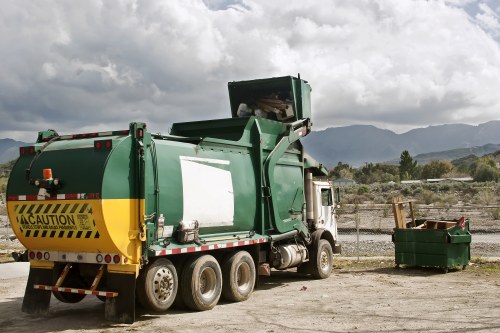
Not every builders waste job happens on a commercial site. Many come from homes, flats and mixed-use properties where a local contractor, landlord or owner has completed improvements and now needs the remaining debris removed. In those situations, the service can be combined with wider property clearance where there are other unwanted items alongside the building waste. The focus remains on clearing what is left behind after the works, rather than on general cleaning or decoration.
For domestic projects, the waste may be spread across several rooms, loft spaces, garages or outdoor storage areas. A kitchen refurbishment might leave broken cabinets, tiles and packaging in one space, while a bathroom update produces a separate pile of ceramics and fittings elsewhere. A property clearance approach is useful when the job extends beyond one pile and involves multiple parts of the building that need attention in a single visit. It can also help when the aim is to hand a property back in a tidier, more workable state.
The practical decisions remain the same: what is present, what is accessible, and what should be removed together. A concise description saves time and avoids confusion, especially when the waste includes mixed household items as well as construction debris. If there are items that must stay on site, make that clear in the note you send. It is always easier to remove the right material when the boundaries are well defined.
Rubble, Heavy Waste and Load Handling
Heavy builders waste needs careful handling because weight affects every stage of the work: lifting, loading, transport and sorting. Bricks, concrete, tiles and similar debris can quickly become cumbersome, particularly where the waste has been broken up into smaller fragments. Our service is intended to remove those dense loads efficiently while still paying attention to safe movement and sensible stacking. The key is to deal with the load as it has been left, not to ask the customer to redesign it.
If a project produces a lot of mineral waste, it is often better to keep that material separate from lighter items. That makes lifting more manageable and helps avoid unnecessary mixing on site. The same principle applies to wet or dusty waste, which should not be bundled together with items that are likely to shift or tear. Where suitable, bulk waste collection can be a practical fit for substantial one-off loads that need moving away in an orderly way.
Good preparation here is less about tidying for its own sake and more about making the collection straightforward. Piles should be stable, paths should be clear enough to move them, and any likely obstructions should be mentioned before the visit is arranged. If the material has sharp edges, loose nails, broken glass or awkward dimensions, say so. The quotation is more useful when it reflects the real effort involved rather than a vague estimate based on a tidy pile that does not exist.
Recycling, Disposal and Responsible Sorting

Construction waste is rarely suitable for one-bin disposal, and many loads benefit from sorting before the final disposal stage. Different materials can often be separated so that recyclable items, reusable components and residual waste are handled in the most appropriate way available. That does not change the fact that the waste still needs to leave the site promptly; it simply means the route out is planned with more care than a single tip run.
We also provide related services such as waste disposal and recycling and sustainability information for customers who want a better understanding of what happens once the material is removed. The useful point for the customer is not the paperwork itself, but knowing that mixed building waste does not need to be treated as if every item ends up in the same place. Proper sorting can make the overall clearance more orderly and less wasteful of time and vehicle space.
When considering disposal, it helps to think about the texture and condition of the waste as well as the item type. Dry timber, clean offcuts, inert rubble and packaged material may be managed differently from contaminated, wet or broken waste. If the job includes anything that may require a separate handling method, flag that early. That allows us to plan the collection more accurately and prevents awkward surprises when the pile is already at the kerb or waiting inside the property.
Choosing the Right Service Level
Different jobs call for different levels of involvement. Some customers need a simple collection from a prepared pile, while others need a more hands-on clearance where material is gathered from several places before loading. The right service depends on the amount of waste, the layout of the property and how much sorting has already been done. Choosing the correct level at the start makes the job more efficient and avoids paying for effort that is not needed.
For smaller or more defined loads, a straightforward waste collection can be enough. For larger or more mixed projects, a broader clearance service may be the better match. The important thing is that the service should fit the work, not the other way around. When a room strip-out leaves a single manageable pile, that is one kind of job; when a refurbishment leaves debris in several rooms, that is another. A sensible quotation reflects that difference.
Think about whether the waste is ready to remove, whether it needs carrying from multiple floors, and whether it contains material that is best kept separate. Those three questions are often enough to narrow the most suitable option. If you are unsure, describe the site plainly and let the service be matched to the load. Clear information is more valuable than guesswork, especially on time-sensitive building work where the last stage depends on the waste going first.
About London
London is a city shaped by centuries of layered growth, with Roman origins, medieval streets, Georgian terraces, Victorian infrastructure and extensive twentieth-century rebuilding all visible in different districts. The River Thames remains the defining geographical feature, cutting through the centre and linking a sequence of bridges, embankments and riverside precincts. Its wider landscape includes royal parks such as Hyde Park and Regent’s Park, large commons in the inner boroughs, and a dense network of streets that range from historic lanes to planned post-war estates. The city’s architectural variety is one of its most recognisable qualities: St Paul’s Cathedral stands among financial towers, while the Tower of London, Westminster Abbey and the Palace of Westminster anchor the story of government, monarchy and civic life. Museum districts around South Kensington, the British Museum in Bloomsbury, and the Tate sites on either side of the river give the capital a strong cultural profile. Transport infrastructure also shapes the city’s identity, from the Underground and mainline termini to the river crossings, canals and walking routes that connect neighbourhoods with very different characters. Markets, theatres, galleries, universities and places of worship sit alongside business districts and residential areas, creating a city that is both international and intensely local at street level. Even within a single borough, contrasts can be sharp, with conservation squares, industrial estates, terraces, tower blocks and regenerated waterfronts often sitting close together. That mixture is part of what makes London distinctive: it is not one single urban form, but a collection of overlapping places that reflect changing centuries of work, movement, housing and public life.
Pricing, Project Details and Quotation Requests

Quotations for builders waste are usually shaped by the amount to be removed, how easy it is to access, and whether the load contains heavy or awkward material. A pile of clean offcuts is not the same as mixed rubble with tiles, plaster, timber and packaging, and the quotation should reflect that difference. If the work is in a basement, upper floor or busy shared entrance, access can also be part of the calculation because the labour involved is different from a simple ground-level pickup.
We can also discuss related options such as pricing and quotes when you want a clearer picture of how the job may be assessed. The best enquiry is usually a short, factual one: what the waste is, how much there is, where it is located and when it needs to be gone. If there are photos, they help; if there are not, a precise description still works. The aim is to make the quotation relevant, not to turn the process into paperwork for its own sake.
If you need builders waste removed in London, request a quotation today and we will help you match the service to the load, the property and the schedule. We are ready to take on mixed construction debris, post-refurbishment waste and other site clearances that need a practical solution. Contact us for a quotation when you are ready to share the details.